Short answer: usually yes, and Colorado is one of the better states in the country for it.
That surprises people. The assumption is that roofing is a summer trade and anything after Halloween is either impossible or a corner-cutting job. Neither is true here, but the reasons why require understanding what actually limits cold-weather roofing. It is not the air temperature on your thermometer. It is what happens to asphalt at low temperatures and whether the sun comes out.
We at MultiPro Exteriors install through Colorado winters. We also tell homeowners to wait until spring more often in December than in any other month. Here is how to tell which one you are.
What Cold Actually Does to a Roof Installation
Three separate problems, and they have different solutions.
Problem 1: Shingles get brittle
Asphalt shingles are flexible at moderate temperatures and stiff when cold. A cold shingle resists bending, and forcing it can crack the mat or fracture it at the nail line. This affects tear-off as much as installation, because removing brittle shingles generates more fragments and more debris.
The practical consequence is slower work and more careful handling. Experienced crews keep bundles warm until immediately before use rather than leaving them staged on a cold roof all morning. Shingles that have been sitting outside overnight at 15 degrees handle very differently than shingles brought from a warmed truck.
Problem 2: The self-sealing strip needs heat to activate
This is the real technical constraint and the one that matters most.
Every asphalt shingle has a strip of thermally activated adhesive on it. When the roof warms, that adhesive softens and bonds each shingle to the one below it. That bond is what gives your roof its wind resistance. Without it, you have shingles that are nailed down but not sealed to each other, and wind can get underneath them.
The adhesive does not activate at low temperatures. Manufacturers publish minimum temperatures for their products, and the commonly cited threshold sits in the range of 40 to 50 degrees Fahrenheit of roof surface temperature. Note that roof surface temperature is not air temperature. A dark roof in direct sun can be substantially warmer than the air around it.
The solution is hand-sealing, and it is not a shortcut. It means the installer applies asphalt roofing cement manually beneath each shingle tab at the specified locations, in the specified quantity, creating the bond mechanically instead of waiting for the sun to do it. Manufacturers publish hand-sealing requirements for cold-weather installation, and following them keeps the warranty intact.
Hand-sealing done correctly is slower and adds labor. Hand-sealing done incorrectly, or skipped entirely with the assumption that the roof will seal itself in spring, is exactly the failure mode that gives winter roofing a bad reputation.
Ask the question directly: will you hand-seal, and to which manufacturer specification? A crew that has an immediate, specific answer has done this before.
Problem 3: Sealants and adhesives have temperature ranges
Flashing sealants, ice-and-water shield adhesion, and underlayment all have their own cold-weather limits. Self-adhering ice-and-water membrane in particular needs adequate temperature to bond properly to the deck, and some products require primer below certain temperatures.
This is detail work rather than a barrier, but it is detail work that gets skipped when a crew is cold and rushing.
Why Colorado Is Actually Good at This
Here is the part that distinguishes us from most cold states, and it is a genuine advantage rather than a sales line.
We get sun. Colorado averages a large number of clear or mostly clear days annually, including through winter. A dark asphalt roof in direct high-altitude sun warms considerably above ambient air temperature. A 35-degree January afternoon with full sun on a south-facing slope can put the roof surface in the range where sealant strips activate on their own.
Our snow does not linger the way it does in the upper Midwest. Front Range snow frequently melts off within days. That gives crews workable windows rather than a continuous four-month shutdown.
Our humidity is low. Dry conditions mean less moisture on the deck and better adhesion for self-adhering products.
Our winter days swing warm. A 20-degree morning and a 50-degree afternoon is an ordinary Front Range December day. Crews can start with tear-off and prep in the cold and do the temperature-sensitive work during the warm part of the day.
The same freeze-thaw cycling that damages roofs here also gives us install windows that Minneapolis does not get.
How Crews Adapt
If a winter installation is done properly, these are the things happening.
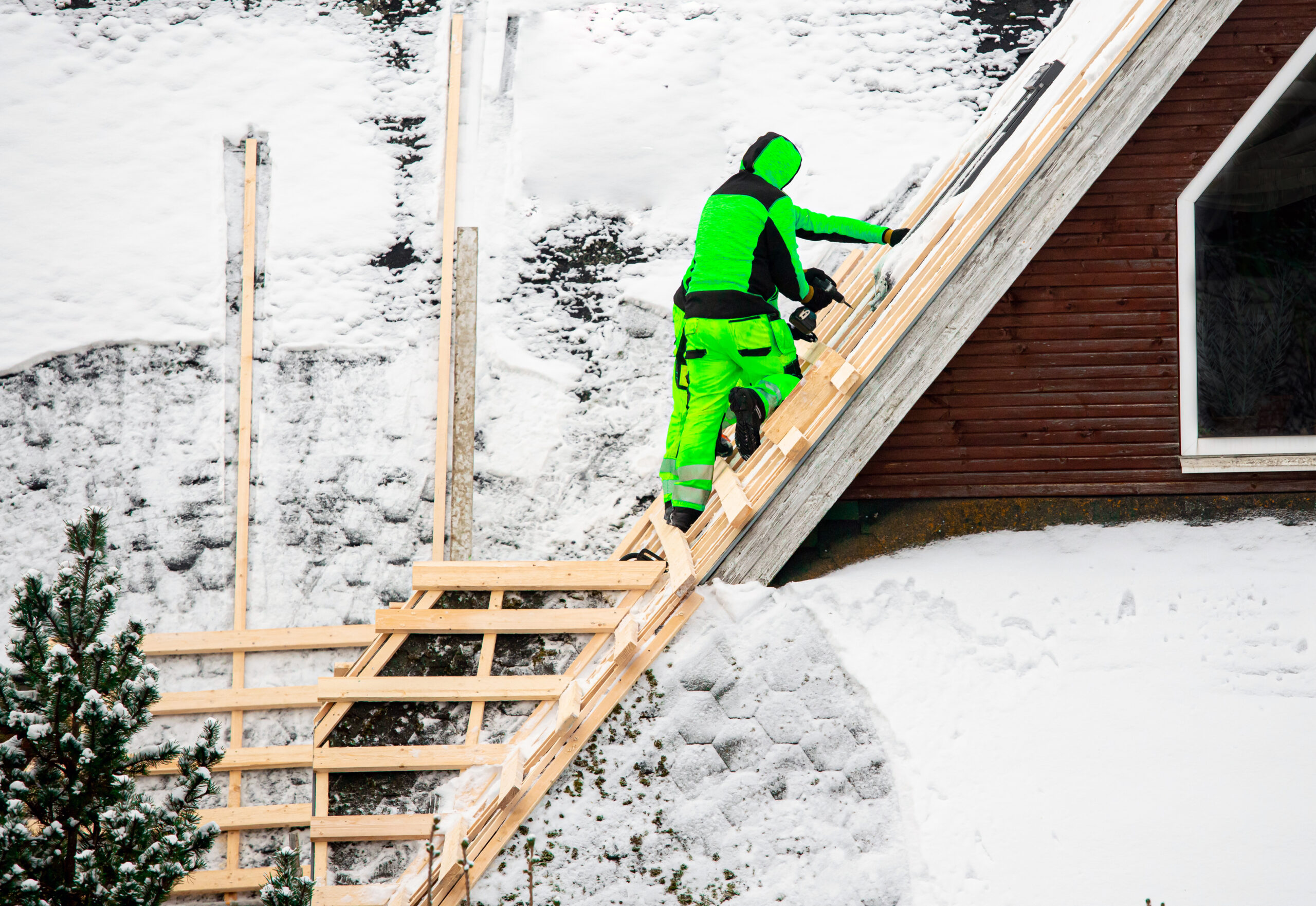
Staged tear-off. Rather than stripping the whole roof at once, the crew removes and replaces one section at a time, keeping the rest of the roof intact and the house protected. Section sizes are set so each area gets dried in the same day. This is the single most important adaptation, because an open deck overnight in winter is unacceptable.
Dry-in the same day, every day. No section stays exposed past the end of the workday. Underlayment goes down over any deck that has been opened.
Working with the sun. Crews start on the slope that gets the earliest sun and follow it around the house. On a clear day this is a meaningful difference in surface temperature.
Warm material handling. Bundles stored in a heated space or a warmed trailer, brought up as needed rather than staged cold.
Hand-sealing to specification. As described above.
Weather monitoring with real flexibility. A crew that will reschedule for an incoming storm rather than pushing to finish is a crew you want. One that works through a snowfall to make its schedule is not.
Longer timelines. A winter roof takes more days than the same roof in September. Anyone promising identical timing is either not adapting or not telling you.
When Waiting Until Spring Is the Right Call
This is the honest part, and it is the section that should determine your decision more than anything above.
Wait if your roof is not leaking and is not storm damaged. A roof at year 22 of a 25-year life is on the clock, but it is not an emergency. Waiting until March or April costs you nothing, gets you better conditions, and gives you time to collect multiple written estimates without pressure. This describes most homeowners who ask us the question in December.
Wait if sustained cold is in the forecast. A stretch of highs in the teens and twenties with no sun is not the week to do this. Good crews will say so.
Wait if the roof has significant complexity. Multiple valleys, steep pitch, a lot of penetrations, or extensive flashing work all mean more temperature-sensitive detail work. Complexity and cold together are a bad combination.
Wait if you have unresolved insurance questions. If your roof is part of a claim that has not been scoped and approved, rushing the work in winter can complicate the claim. Sort the claim first. Our post on hail damage claim deadlines in Colorado covers the sequence.
Wait if the only contractor willing to do it right now knocked on your door. Post-storm door knockers pushing a January install date are creating urgency that serves them, not you.
Do not wait if there is active water intrusion. A leak in winter is not something to manage until spring. Water in your decking and insulation compounds through every freeze-thaw cycle, and wet insulation makes the ice dam problem worse, which makes the next leak worse. Get it stopped.
Do not wait if the roof has failed structurally, if a section has been lost to wind, or if a tree strike has opened the deck.
Tarping: What It Is Good For
Emergency tarping is the bridge between “this is leaking now” and “this can be properly replaced when conditions allow.”
A properly installed tarp is fastened, sealed at the edges, and secured over the affected area with enough overlap to shed water and survive wind. It is not a sheet of plastic weighted with bricks.
What tarping does: stops active water intrusion, prevents further interior damage, buys you time to scope the work properly and get through the insurance process, and preserves your negotiating position instead of forcing a rushed decision.
What tarping does not do: last the winter reliably without inspection, or substitute for a repair. Tarps degrade under UV and wind. Check yours after every storm.
Most policies cover reasonable emergency mitigation and require you to prevent further damage once you know about it. Keep the receipts. If you have an active leak right now, our guide to the first 48 hours after winter roof damage covers the immediate sequence, and emergency roof repair is what to call for.
Questions to Ask Before Booking a Winter Roof
- What is the manufacturer’s minimum temperature for this shingle, and will you hand-seal below it?
- Which specific hand-sealing method and quantity does the manufacturer require, and will you follow it?
- Does cold-weather installation affect the manufacturer warranty in any way?
- How will you stage tear-off, and what happens if weather turns mid-section?
- Will any part of my deck be open overnight? The answer should be no.
- How do you store and handle shingles to keep them from getting brittle?
- What is your reschedule policy if the forecast changes, and does it cost me anything?
- How much longer will this take than the same job in September?
- How do you handle ice-and-water shield adhesion at these temperatures?
The hand-sealing question is the one that separates crews. There is a correct, specific answer, and a contractor who fumbles it should not be doing your roof in January.
The Bottom Line
Winter roof replacement in Colorado is legitimate work when it is done with staged tear-off, same-day dry-in, proper hand-sealing, and a crew willing to reschedule around weather. Our sun and our dry, swinging winters make it more workable here than in most cold-climate states.
But if your roof is intact and simply aging, the honest recommendation is to wait for spring, plan it properly, and get competitive written estimates without a leak forcing your hand. We tell homeowners that regularly, and we would rather say it than book a job you did not need to do in February.
If you have an active leak or storm damage, that is a different conversation and it should happen today.
We provide free written roofing assessments across Denver, Aurora, Lakewood, Thornton, Westminster, Littleton, Centennial, Parker, Highlands Ranch, Castle Rock, Boulder, Broomfield, Golden, and Wheat Ridge, including a straight answer on whether your roof should be done now or in April. Get a written estimate or a second opinion on a winter quote you have already received.
Frequently Asked Questions
Can shingles be installed in cold weather?
Yes, with adaptations. Shingles get brittle, and their self-sealing adhesive strips do not activate at low temperatures, so crews hand-seal with roofing cement to manufacturer specifications, stage tear-off in sections, and dry in every section the same day.
How cold is too cold for roofing?
Manufacturers publish minimum temperatures, commonly in the range of 40 to 50 degrees Fahrenheit of roof surface temperature for self-sealing, with hand-sealing required below that. Roof surface temperature matters more than air temperature, since a dark roof in Colorado sun runs warmer than the ambient air.
Does a winter roof installation void the warranty?
Not if the installation follows the manufacturer’s cold-weather requirements, including hand-sealing. Ask your contractor to confirm the specific requirements for the shingle being installed and to document that they were followed.
Should I wait until spring to replace my roof?
If your roof is not leaking and not storm damaged, waiting is usually the better call. You get better installation conditions, more competitive estimates, and no pressure. If there is active water intrusion or structural damage, do not wait.
How does emergency tarping work?
A properly installed tarp is fastened and sealed over the affected area to stop water intrusion until a permanent repair is possible. It is a temporary measure that needs checking after storms, not a substitute for a repair.
Will my house be exposed during a winter roof replacement?
It should not be. Proper winter practice is staged tear-off, where the crew opens only the section it can dry in the same day. No part of your deck should be left open overnight.