Kansas winter does not get the respect it deserves.
Wichita homeowners spend the year braced for hail and tornadoes, and reasonably so. But the damage that shows up in a February insurance claim is usually not dramatic. It is an ice-loaded limb that came down on a garage roof, or shingle tabs that lifted in a 50 mph January wind, or a hail bruise from last May that finally opened up after twenty freeze-thaw cycles.
Generic Midwest-winter advice does not cover south-central Kansas well. Our winters are not Minnesota’s. They are wetter, warmer, windier, and they cycle above and below freezing constantly, which produces a different failure pattern.
Here is what actually goes wrong on Wichita roofs in winter, what to check before the first ice event, and what to do when a storm takes out your power and your access. We at MultiPro Exteriors work in hail country in two states, and the Kansas winter profile is genuinely distinct.
The Three Kansas Winter Threats
Ice storms and load
This is the defining Kansas winter hazard, and it is different from a snow event in a way that matters.
Kansas sits in a corridor where winter precipitation frequently falls as freezing rain rather than snow. Warm air aloft melts falling snow, and it refreezes on contact with cold surfaces below. The result is accretion: a layer of clear ice bonded directly to every surface it touches.
Ice is dramatically heavier than snow for the same visual thickness. A significant accretion event puts real static load on your roof structure, your gutters, and every tree limb on your property.
The roof itself is usually not the failure point. The failure points are:
Tree limbs. Ice loading on branches is where most Kansas winter roof damage originates. A limb that carried its own weight fine all year snaps under an ice load and lands on a roof, a gutter run, or a service line. Wichita’s mature tree canopy, particularly the older neighborhoods with large hackberry, elm, silver maple, and Bradford pear, is a liability in an ice storm. Bradford pear in particular is notorious for splitting.
Gutters. Ice in the trough plus ice on the exterior surface plus any debris load is more weight than builder-grade hangers were spaced for. Gutters pull away from fascia and sometimes take the board with them.
Power lines and service drops. Ice on lines plus falling limbs equals outages, and outages are what turn a manageable situation into a serious one.
Sustained plains wind
Kansas wind is different from mountain wind. It is not gust-driven bursts off a foothill; it is sustained flow across open terrain with long fetch and nothing to break it up.
That distinction matters for roofs. Sustained wind pressure works on the same shingle tab continuously for hours rather than hitting it once hard. The result is progressive failure of the sealant bond between shingle courses. A tab does not tear off in one event. It gets worked loose over a season, and then a spring storm drives water underneath it.
Where sustained wind concentrates:
Ridge caps. The most exposed component on the roof and the most commonly damaged in Kansas wind. Ridge cap shingles sit at the pressure peak.
Rake edges and eaves. Wind gets under the edge and lifts. Missing or inadequate drip edge and rake metal make this substantially worse.
Corners and perimeter zones. Uplift pressure is highest at roof corners and along the perimeter, which is why building codes specify enhanced fastening in those zones. Ask whether your last roof was installed with perimeter enhancement.
Field shingles on the windward slope, typically south and west facing across most of the Wichita area.
Vents, turbines, and flashing. Loose fasteners become loose components.
Wind also drives precipitation horizontally, which defeats water-shedding assemblies that work fine under vertical rain. A wind-driven ice event pushes water into places a normal rain never reaches.
Freeze-thaw working existing hail damage
This is the mechanism most Wichita homeowners underestimate, and it is why an unrepaired hail bruise from May becomes a January leak.
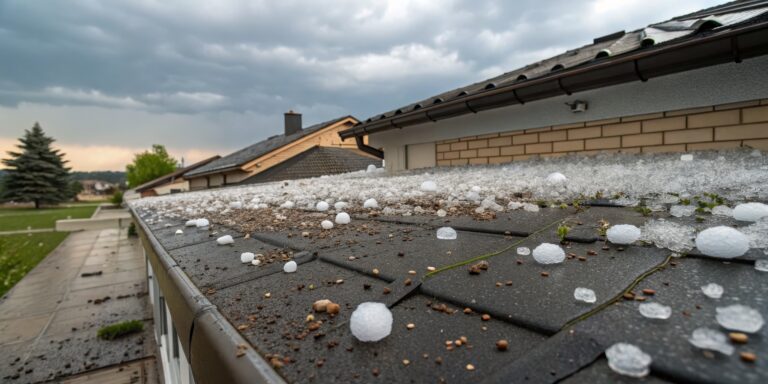
Here is the sequence. Hail fractures the asphalt mat beneath the granule surface without breaching the shingle. The roof still sheds water. Summer sun dries and embrittles the exposed asphalt. Then winter arrives.
Water enters the fracture on a thaw day. Temperature drops overnight. Water freezes and expands roughly nine percent, widening the crack. It thaws the next afternoon, admits more water, and freezes again.
South-central Kansas gets a lot of these cycles, because our winters hover around the freezing point rather than staying well below it. A hard, consistently cold winter produces fewer cycles than a mild oscillating one. Kansas gets the oscillating kind.
Repeat that dozens of times across a winter and a bruise you could not see from the ground becomes a hole. The leak that shows up in February is a May storm finally arriving.
The practical implication: if hail hit your neighborhood last spring or summer and nobody has documented your roof, winter is when you find out what it did. Our post on why Wichita homeowners should prepare for hail season in winter covers the documentation side of this.
The Pre-Winter Checklist
Run this before the first hard freeze. Most of it is ground-level or ladder-at-the-eave work. Do not walk the roof.
Trees first
This is the highest-value item on the list for Kansas specifically, and it is the one most homeowners skip.
- Remove or shorten any limb overhanging the roof, and any limb that would reach the roof if it fell.
- Look specifically for dead or dying limbs, since those fail first under ice.
- Check for co-dominant stems and tight branch unions, which split under load.
- Identify limbs near your service drop and call the utility rather than handling those yourself.
- Pay particular attention to Bradford pear, silver maple, hackberry, and elm, all of which are common in Wichita and all of which handle ice poorly.
Hire an arborist for anything substantial. Ice-loaded limb removal after a storm is dangerous and expensive; preventive pruning in October is neither.
Gutters and drainage
- Clear all gutters and downspouts completely. A gutter full of frozen leaves is a solid block of ice.
- Confirm water runs to the downspout with no standing pools. Run a hose to check.
- Push up on the gutter to test the hangers. Loose fasteners fail under ice load.
- Probe the fascia with a screwdriver. Soft wood means the gutter has nothing solid to hang from.
- Verify downspouts discharge well away from the foundation and that grade slopes away.
- Note any dents from hail, which may be claimable.
See gutter repair and installation if any of that turned up problems.
The roof, from the ground and the ladder
- Scan each slope with binoculars in low-angle light. Look for missing shingles, lifted tabs, and uneven color where granules have thinned.
- Look hard at the ridge line. Ridge cap damage is the Kansas signature and it is visible from the ground.
- Check rake edges and eaves for lifted or missing metal.
- Look for granules in the gutter debris, which indicates the roof is shedding.
- From the ladder, inspect the first course of shingles at the eave and the drip edge.
Flashing and penetrations
- Chimney flashing, particularly the counterflashing at the masonry joint.
- Pipe boots. The rubber collars around plumbing vents crack from UV, usually around year 10 to 15, and they are the single most reliable leak source on any roof.
- Roof vents and turbines for loose fasteners and lifted flashing.
- Any wall-to-roof transition, which needs step flashing rather than caulk.
The attic
- Go up on a bright day, turn off your flashlight, and look for daylight through the decking.
- Check for staining on the underside of the decking and on rafters.
- Feel for damp or matted insulation, especially near the eaves.
- Verify insulation has not been pushed into the soffit vents and blocked the intake. This is extremely common and it directly causes ice buildup at the eave.
- Confirm bath and kitchen fans vent outside the building rather than into the attic.
- Look for frost on the underside of the deck, which indicates warm moist air escaping from the living space.
Interior and preparation
- Walk your top-floor ceilings in daylight with the lights off, looking for faint staining along exterior walls and in corners.
- Locate your water shutoff and know how to reach your electrical panel.
- Photograph your roof, gutters, and exterior now, while conditions are good. A dated set of photos showing your roof in known condition is the best protection you have against a future carrier arguing pre-existing damage.
- Have a tarp, a headlamp, and a few buckets somewhere you can find them in the dark.
Ice at the Eave in Kansas
Ice buildup at the eave, commonly called an ice dam, happens in Wichita too, though the driver is somewhat different than in a heavy-snow market.
The mechanism is the same: heat escaping from the living space into the attic warms the roof deck, snow or ice melts from underneath, the meltwater runs down and refreezes at the cold eave beyond the heated envelope. Repeated cycles build a ridge that backs water up under the shingles.
In Kansas, the freezing-rain profile adds a wrinkle. An accretion event can glaze the entire roof surface, including the drainage path, so meltwater arriving from a warmed upper slope has nowhere to go even before a dam forms.
The fix is the same in both markets, and it is not on the roof. It is in the attic: air seal the ceiling plane so heat stops escaping, bring insulation to adequate depth with baffles preserving the soffit air path, and balance intake and exhaust ventilation. Ice-and-water shield at the eaves, which can only be installed during a roof replacement, protects against intrusion if a dam forms anyway.
Do not chip at ice with tools, and do not use salt or ice melt on the roof or in the gutters. Both damage shingles and metal.
When a Storm Hits: Power Out, Access Blocked
Ice storms in Kansas mean outages, and outages change what you can do.
Immediate, before anything else. If a limb is on your roof or a line is down, treat every downed line as energized and stay away from it. Call the utility. Do not attempt limb removal from a roof under any circumstances during or after an ice event.
If water is coming in, contain it with buckets and plastic sheeting. If a ceiling is bulging with trapped water, a small relief hole at the low point drains it in a controlled way and prevents a larger collapse, with a container underneath. Cut power to any circuit where water is near fixtures or wiring.
Photograph everything before you clean up. Wide shots and close shots, interior and exterior, with something for scale. This is your claim documentation, and you cannot recreate it later.
Do not get on an icy roof. Not to tarp, not to look, not for anything. Tarping an ice-covered roof is a professional job and frequently has to wait for conditions.
Heat and safety during an outage. Never run a generator, grill, or any combustion appliance indoors or in a garage. Never heat with a gas oven. Carbon monoxide kills more people after ice storms than the storms do.
Call for emergency service early. After a regional ice event, response queues fill within hours. Calling at hour two puts you in a different position than calling at hour twenty.
Our guide to the first 48 hours after winter roof damage covers the full emergency sequence, and emergency roof repair is what to call for when water is actively coming in.
After the Storm
Document before you repair. Photos of everything, dated, before any cleanup beyond stopping active damage.
Keep receipts for emergency mitigation. Tarping, water extraction, board-up. Most policies cover reasonable mitigation costs and require you to prevent further damage once you know about it.
Get a documented inspection. Wind damage is frequently underscoped because lifted tabs that have not yet blown off do not look like damage from the ground. They are damage, and they are the reason the roof leaks in April.
Read your own policy. Kansas homeowners policies vary considerably in how they handle wind and hail, including separate deductibles, roof age schedules, and cosmetic exclusions. Check your declarations page and confirm your deductible and coverage terms with your carrier directly. No contractor can tell you how your claim will be decided, and any contractor offering to absorb your deductible is proposing something you should walk away from.
Be careful who you hire. Post-storm crews arrive fast. Ask for a certificate of insurance and call the carrier listed on it. Ask for local references from the last two years and call one. Ask for a written, line-itemed estimate before you sign anything. Verify licensing requirements with your local jurisdiction, since they vary across Sedgwick County and the surrounding municipalities.
Get It Documented Before Winter Sets In
We serve Wichita and the surrounding communities, including Derby, Andover, Maize, Goddard, Haysville, Bel Aire, Park City, and Newton, plus Sedgwick County broadly and adjacent parts of Butler, Harvey, and Sumner Counties.
A pre-winter inspection gives you two things: any problems found while they are still inexpensive to fix, and a dated written record with photographs of your roof’s condition going into the season. That second one matters more than homeowners expect, particularly if you have unrepaired hail damage from last spring that freeze-thaw is about to find.
Free inspection, written report with photographs, and an honest answer if the answer is that your roof is in good shape. See residential roofing or contact us to schedule.
Frequently Asked Questions
What causes ice storm roof damage in Kansas?
Falling tree limbs under ice load are the most common cause, followed by ice weight pulling gutters off fascia. The roof structure itself usually holds. Freezing rain accretion also glazes drainage paths, which can back water up at the eaves.
How does wind damage shingles in Wichita?
Sustained plains wind works the sealant bond between shingle courses progressively rather than tearing tabs off in one event. Ridge caps, rake edges, eaves, and roof corners fail first. Loosened tabs often do not leak until a later storm drives water underneath.
Can hail damage from last spring cause a leak in winter?
Yes, and it is a common pattern. Hail fractures the shingle mat without breaching it, then freeze-thaw cycling widens those fractures repeatedly through winter until water gets through. South-central Kansas gets many cycles because winter temperatures hover near freezing.
What should I do if a tree limb falls on my roof during an ice storm?
Stay off the roof and treat any downed line as energized. Call the utility for line issues. Contain interior water, photograph everything, and call for professional emergency service. Do not attempt limb removal from an iced roof.
How do I prepare my roof for a Kansas winter?
Trim or remove overhanging and dead limbs, clear and secure gutters, check ridge caps and rake edges for wind damage, inspect flashing and pipe boots, verify attic insulation and unobstructed soffit ventilation, and photograph your roof’s current condition for your records.
Does homeowners insurance cover ice storm roof damage?
Coverage varies by policy, and Kansas policies differ in how they treat wind and hail, including separate deductibles and roof age schedules. Read your declarations page and confirm terms with your carrier directly.