Nobody has ever been excited about their gutters. They are the least interesting thing on your house, right up until the afternoon you find water in your basement and cannot figure out where it came from.
Gutters do one job: move water away from your foundation. When they stop doing it, the failure does not show up at the gutter. It shows up as rotted fascia, ice hanging off your eaves, a stained ceiling, or a wet crawlspace. By then, you are not paying for gutter work anymore.
October is the month to handle this on the Front Range. Here is when to clean, how to spot the problems that actually matter, and where the money goes if you skip it. We at MultiPro Exteriors pull a lot of leaves out of a lot of gutters every fall, and the patterns are consistent.
When to Clean Gutters in Colorado
The timing question has a real answer here, and it is later than most people assume.
Front Range tree cover is dominated by cottonwoods, ash, elm, honeylocust, and maple. Those species do not drop on the same schedule as the oaks and maples that set the calendar in guides written for the Midwest and Northeast. Cottonwoods along the creeks and ditches shed heavily and late. Ash holds leaves well into fall.
Clean after your trees are actually bare, which on most of the Front Range means mid to late October. Clean in September and you will be doing it again in November.
If you have significant tree cover, plan on two passes: a mid-October clearing and a final check in early November before the first hard freeze. If you have no trees near the house, one late-October pass is usually enough, though you still need to check for shingle granules and windblown debris.
The one deadline that is not flexible: get it done before the first sustained freeze. A gutter full of wet leaves that freezes solid is a gutter full of ice, and ice weighs roughly eight pounds per gallon. That load is what pulls hangers out of fascia.
The Ten-Minute Gutter Assessment
You can diagnose most gutter problems from a ladder at the eave and a garden hose. Do not walk the roof.
Check the pitch
Gutters should slope toward the downspout, generally around a quarter inch of drop for every ten feet of run. Too flat and water stands. Too steep and it overshoots the outlet.
The test: run a hose into the far end of the gutter and watch. Water should move steadily toward the downspout with nothing pooling behind. Standing water after the hose is off means the pitch is wrong or a section has sagged.
Standing water is not a cosmetic issue. It accelerates corrosion, breeds mosquitoes in summer, and in winter it is the seed of an ice problem.
Check for separation and seam failure
Look at every joint, corner, and end cap. Aluminum gutters expand and contract with temperature, and Colorado gives them a lot of expansion and contraction. Sealant at seams eventually fails.
Look for gaps you can see light through, dried and cracked sealant, water staining on the fascia directly below a seam, and mitered corners that have pulled apart.
Check the hangers and fasteners
Old gutters were hung with spikes and ferrules. Spikes back out over time. Newer systems use hidden hangers screwed into the fascia, which hold considerably better.
Push up gently on the gutter. Movement means loose fasteners. Look for hanger spacing that is too wide, which is common on builder-grade installs and is exactly what fails under snow load.
Check the fascia and soffit behind the gutter
This is the part people skip and it is the most expensive thing on the list.
Probe the fascia board with a screwdriver. Firm wood resists. Soft or spongy wood means water has been running behind the gutter, likely for seasons. Look for peeling paint, dark staining, and any daylight visible between the gutter back and the fascia.
Rotted fascia is not a gutter repair. It is a carpentry repair, and once it is soft the gutter has nothing solid to hang from.
Check the downspouts and discharge
Downspouts are half the system and get a fraction of the attention.
- Are they clear? Tap along the length. A dull thud instead of a hollow ring means a clog.
- Are the elbows and connections intact?
- Do they discharge at least four to six feet from the foundation? Splash blocks alone often are not enough on clay soils.
- Is the grade sloping away from the house at the discharge point, or is water pooling against the foundation?
- Are any downspouts dented from hail? That is worth noting, since it is often part of a storm claim.
A perfect gutter that dumps water at the base of your wall has accomplished nothing.
Check for granules
While you are in there, note how much shingle granule is mixed into the debris. It resembles coarse black sand. Meaningful accumulation, especially concentrated below one slope, is a roof signal rather than a gutter signal. Our guide to checking your roof at the end of hail season covers what that means.
How Gutters Cause Ice Dams
Gutters get blamed for ice dams, and the truth is more specific than that.
An ice dam forms because heat escaping from your living space into the attic warms the roof deck, melting snow on the upper slope. That meltwater runs down and reaches the eave, which is beyond the heated envelope and therefore cold. There it refreezes. Repeat over several days and you build a ridge of ice that backs water up under your shingles.
Gutters do not cause that mechanism. They make it worse in two specific ways.
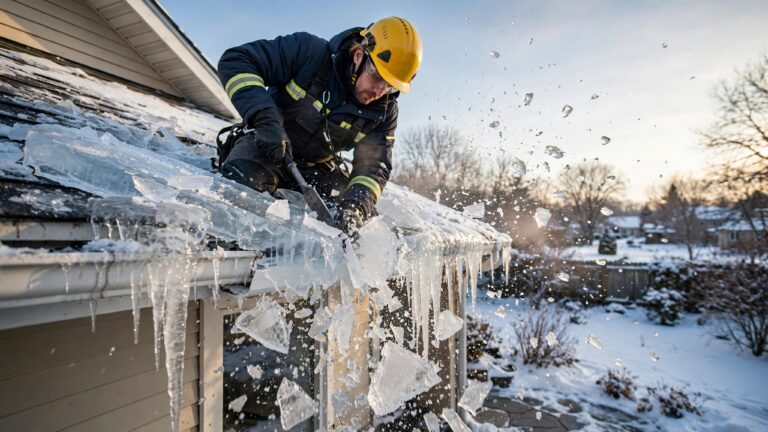
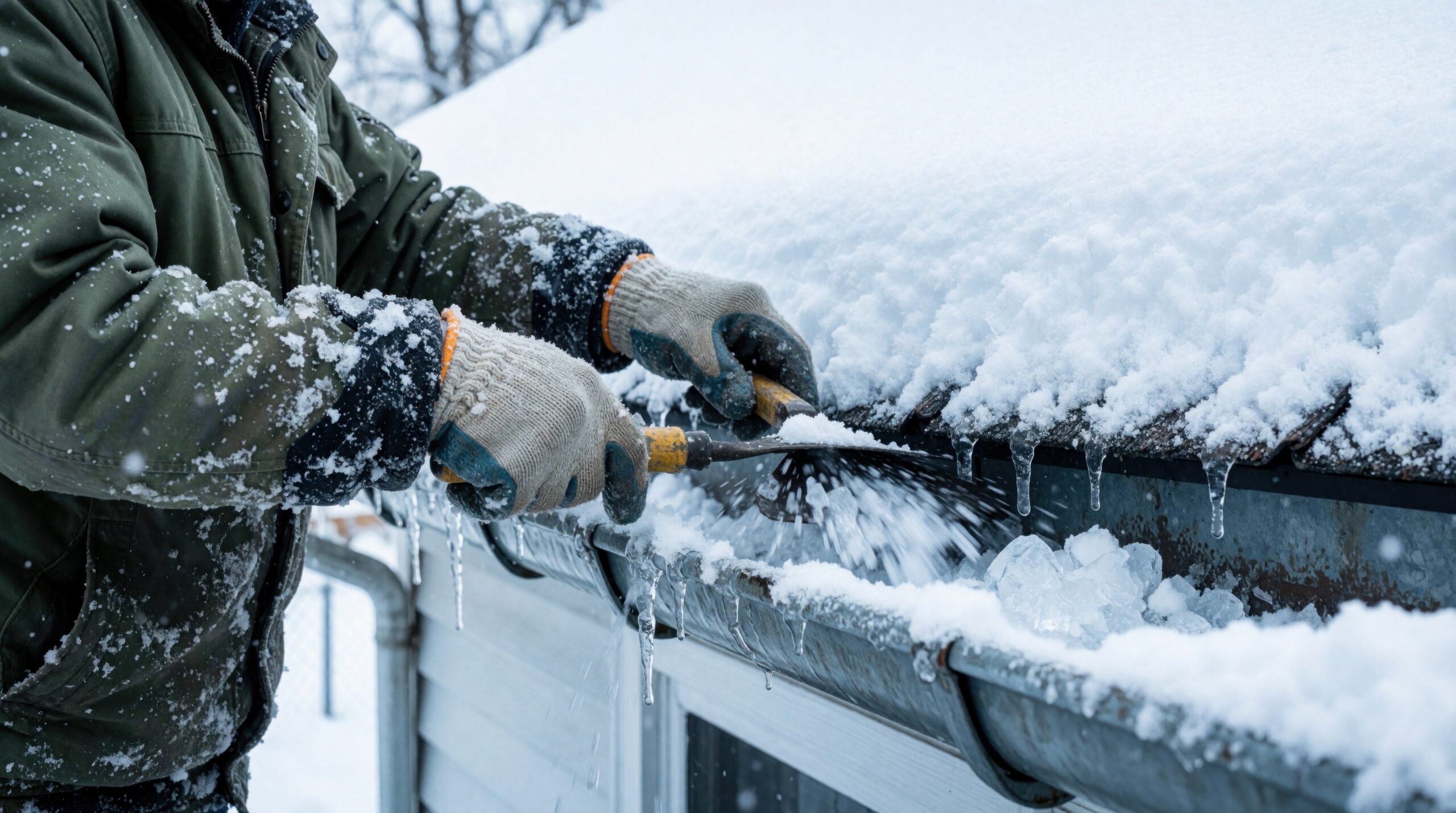
First, a clogged gutter gives the ice a starting point and a form to build against. Instead of meltwater running off the edge, it sits in a trough of frozen debris and freezes there, growing upward onto the roof surface.
Second, a gutter full of ice is dead weight at the exact worst location. Combine ice load with loose hangers or soft fascia and you get gutters pulling away from the house, sometimes taking the fascia board with them.
The real fix for ice dams is attic insulation, attic ventilation, and ice-and-water shield at the eaves. Clean gutters are necessary but not sufficient. We cover the full mechanism and the three levers that actually solve it in our post on ice dams in Colorado.
What clean, properly pitched gutters do accomplish: they give meltwater a clear path on the days when it is actually flowing, and they remove one of the ingredients.
Are Gutter Guards Worth It at Altitude?
Straight answer: sometimes, and the type matters more than whether.
Where guards earn their keep: heavy tree cover, two-story homes where cleaning is genuinely difficult or dangerous, homeowners who are not going to get up there twice a year regardless of advice, and homes where access requires equipment.
Where they are oversold: homes with little tree cover, and any pitch where you were going to inspect the gutters anyway. Guards reduce cleaning frequency. They do not eliminate it, and any product marketed as never needing maintenance is overpromising.
Colorado-specific considerations that matter more here than in other markets:
- Fine debris. Cottonwood fluff, elm seeds, and pine needles pass through or clog coarse screens. Micro-mesh handles fine debris better but needs occasional brushing.
- Shingle granules. At altitude, roofs shed granules faster. Granules accumulate on top of mesh guards and reduce flow. This is a real and underdiscussed issue with fine-mesh systems here.
- Ice. Some guard designs create a flat surface that ice bridges over, which can make ice problems worse rather than better. Solid-top reverse-curve designs are particularly variable in freeze-thaw climates.
- Snow load. Guards add a surface for snow to sit on. Cheap plastic inserts crack under Colorado snow and UV.
| Guard type | Handles leaves | Handles fine debris | Freeze-thaw performance | Notes |
| Foam inserts | Yes | Poorly | Poor | Degrades in UV, holds moisture, generally not recommended here |
| Plastic screens | Yes | Poorly | Poor | Cheap, brittle at altitude, short life |
| Metal screens | Yes | Partially | Fair | Reasonable middle option |
| Micro-mesh | Yes | Yes | Fair to good | Best debris performance, needs periodic brushing, granule buildup is the drawback |
| Reverse curve | Yes | Partially | Variable | Can shed water past the gutter in heavy flow, ice performance depends on design |
If you go with guards, the honest advice is to fix the pitch, fasteners, and fascia first. Guards on a sagging gutter are a cover over a problem.
Repair or Replace?
Sectional aluminum gutters can be repaired piece by piece. Seamless gutters are run as one continuous piece per elevation, which reduces failure points but means repairs are less modular.
Repair makes sense when:
- The problem is isolated to one or two sections
- Fasteners have loosened but the gutter itself is sound
- Seams need resealing
- A downspout needs replacing or rerouting
- Pitch needs adjusting on an otherwise good run
Replace when:
- Multiple sections sag or have separated
- The gutter is undersized for the roof area it serves, which is common on builder-grade five-inch gutters under large or steep slopes
- There is widespread corrosion or splitting
- Fascia repair requires removing the gutter anyway
- The gutters were damaged by hail as part of a storm claim
- You are replacing the roof, in which case doing gutters at the same time is more efficient
A note on sizing: five-inch K-style is standard, six-inch handles substantially more water. On a large roof, a steep slope, or a valley that concentrates flow onto one run, five inches often cannot keep up. If your gutters overflow in a hard rain despite being clean, the size may be the problem rather than the maintenance.
If you are replacing the roof, get gutter repair and installation scoped in the same conversation. Doing them separately means paying twice for the same access.
What Neglect Actually Costs
This is the section that makes the case better than any argument about maintenance.
Cleaning gutters is inexpensive. What it prevents is not.
Fascia and soffit replacement. Water running behind the gutter rots the board it hangs from. Rot spreads along the run. Repair means removing gutters, replacing carpentry, priming, painting, and rehanging.
Foundation seepage. Water discharging at the base of the wall saturates soil against the foundation. On the expansive clay soils common across the Front Range, saturation cycles cause soil movement, which is a much larger problem than a wet basement. This is the single most expensive downstream consequence of a bad gutter system.
Interior water damage. Ice dams push water under shingles and into the ceiling. Drywall, insulation, paint, and sometimes flooring.
Roof deck rot. Chronic water at the eave rots decking and the lower course of shingles, which turns a gutter issue into a roofing issue.
Landscaping and hardscape. Concentrated discharge erodes beds, undermines walkways, and heaves patios through freeze and thaw.
Pest entry. Rotted soffit is an open door for wasps, squirrels, and birds into the attic.
The ratio is the point. Two cleanings a year is a rounding error against any one of those repairs.
Your October Gutter Punch List
- Wait until trees are bare, generally mid to late October on the Front Range.
- Clear gutters and downspouts completely.
- Run a hose and confirm water moves to the downspout with no standing water.
- Check every seam, corner, and end cap for gaps and failed sealant.
- Push up on the gutter to test fasteners; note anything loose.
- Probe the fascia for softness and look for staining or daylight behind the gutter.
- Confirm downspouts discharge four to six feet out and that grade slopes away.
- Note granule volume in the debris as a roof indicator.
- Fix pitch, fasteners, and fascia before considering guards.
- Do a final debris check in early November before the first hard freeze.
If any of steps four through six turned up problems, get them handled while the weather still cooperates. Fascia repair in December is a different and more expensive job than fascia repair in October.
Get It Sorted Before the Ice Arrives
We repair, replace, and install gutters across Denver, Aurora, Lakewood, Thornton, Westminster, Littleton, Centennial, Parker, Highlands Ranch, Castle Rock, Boulder, Broomfield, Golden, and Wheat Ridge, including seamless runs, six-inch upgrades, downspout rerouting, and fascia repair.
If your gutters are fine, we will tell you that and you can put the ladder away. If the fascia is soft or the pitch is wrong, you want to know now rather than in February.
Schedule a free inspection or ask for a written estimate on what your assessment turned up.
Frequently Asked Questions
When should I clean my gutters in Colorado?
Mid to late October for most Front Range homes, after cottonwoods and ash have dropped. Homes with heavy tree cover benefit from a second pass in early November. The firm deadline is before the first sustained freeze.
Are gutter guards worth it in Colorado?
They help most on homes with heavy tree cover or difficult access, and micro-mesh performs best on fine debris. At altitude, shingle granule buildup on mesh is a real drawback, and some designs handle freeze-thaw poorly. Fix pitch, fasteners, and fascia before adding guards.
Do gutters cause ice dams?
Not directly. Ice dams are caused by heat escaping into the attic and melting snow that refreezes at the cold eave. Clogged gutters make dams worse by giving ice a place to form and by adding weight at the eave.
What are the signs my gutters need replacing?
Multiple sagging or separated sections, widespread corrosion or splitting, standing water after cleaning, loose fasteners across several runs, soft fascia requiring removal to repair, and overflow during hard rain on a clean gutter that is undersized.
How far from the foundation should downspouts discharge?
Generally four to six feet at minimum, with the grade sloping away from the house at the discharge point. On expansive clay soils, extending farther is often worthwhile.